
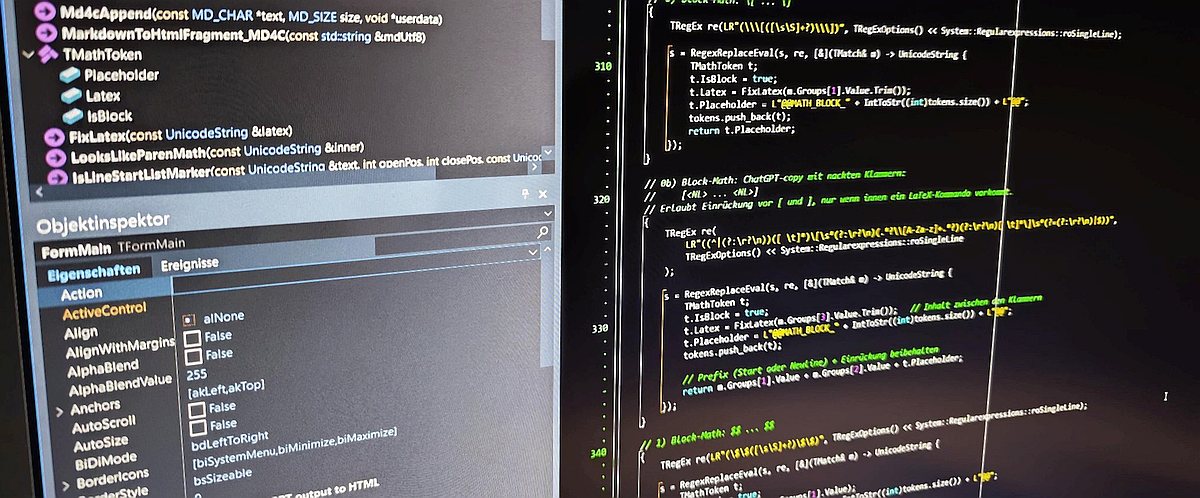
Software development for machine vision, AI and camera systems
Custom development instead of compromises with standard software
Dat-inf develops tailored software solutions for tasks in machine vision, artificial intelligence, data analysis and automation. If standard software is not sufficient or an existing solution does not match your process, data flow or hardware precisely, we develop applications that align with your actual requirements.
Typical development tasks
- Evaluation of 2D, 3D and video data
- Measurement, counting, detection and classification
- Software for camera-based inspection and evaluation systems
- User interfaces for operation, documentation and approval
- Interfaces to databases, machines and third-party systems
- Cloud, web or desktop solutions for analysis and monitoring
What you get from us
- Technical understanding of your subject-matter task
- Pragmatic implementation with robust, maintainable solutions
- Vendor-independent selection of cameras, optics and hardware
- Integration into existing workflows and systems
- Scalability from prototype to production application
Good software is created not only through code, but through a clean connection between the task, data, usability and technical implementation.
Our focus: software for real inspection, measurement and analysis tasks
Many projects begin with a concrete question: Should a part be detected, measured, inspected, counted or evaluated? Does a camera system need to be integrated into a process, an inspection station modernized, or an existing data set evaluated automatically? We develop custom applications precisely for such situations.
Our focus is on solutions that work in everyday use: traceable results, reproducible workflows, clear usability and a technical basis that can be expanded and maintained over the long term.
Typical application fields
- Optical quality inspection and visual inspection
- Camera-based measurement systems for geometry and position
- Color inspection and color-based analysis
- 3D machine vision and depth-data evaluation
- AI-supported classification and anomaly detection
- Analysis of laboratory, research and process data
- Documentation, logging and traceability
- Modernization of existing inspection and evaluation systems
First comes domain understanding
Successful software projects do not arise from fast implementation alone, but from a good understanding of the actual task. That is why we analyze not only technical requirements, but also the domain background: Which features are relevant? Which decisions need to be made? Which borderline cases exist? What does the real workflow look like?
This creates solutions that do not merely work formally, but are reliable in practice. This approach is especially important in machine vision, AI and data analysis because capture conditions, variant diversity and exceptional cases are decisive there.
For new initiatives, a feasibility study is often recommended to clarify early on which solution paths work robustly and which data or hardware are required.
Combine machine vision, AI and classical algorithms sensibly
Classical image and data processing
Many tasks can be solved efficiently with robust classical methods: segmentation, feature extraction, geometric measurement, statistics, rule sets or model-based evaluation. These approaches are often transparent, fast and easy to validate.
AI and machine learning
Where variant diversity, complex patterns or differences that are difficult to describe play a role, we complement classical algorithms with AI methods and machine learning. What matters is not the hype, but which approach offers the best combination of accuracy, stability and maintainability for the specific task.
Integration of cameras, optics and capture hardware
Software for machine vision only works reliably when image capture and hardware also fit the task. That is why, where needed, we support the selection and integration of camera systems, optics, lighting, triggering and suitable computing hardware.
We work independently of manufacturers and select components so that they fit the task, environment and future expandability. This is especially important for industrial applications, inspection stations and measurement systems.
Target platforms and interfaces
Platforms
- Windows desktop applications with graphical user interfaces
- Windows services and server applications
- Linux systems, e.g. for industrial PCs or Raspberry Pi
- Web applications and browser-based interfaces
- Mobile solutions for Android, iOS or PWA
Languages and interfaces
- C++, Python, PHP and Delphi – depending on the task
- REST APIs and web services, e.g. with FastAPI or GO
- Databases, file interfaces and network protocols
- Integration into existing user and process interfaces
- Documentation and tests for stable further development
Develop practically – from prototype to production application
Depending on the project, we first develop a prototype or move directly to a production solution. In early project phases, it is often about checking data, understanding variants and identifying the suitable solution approach. This is followed by step-by-step expansion, integration and validation in real use.
This reduces risks and allows decisions to be made early on a reliable basis. Especially in machine vision and AI, this iterative approach is often significantly more economical than an immediate full implementation without a reliable data foundation.
- Task clarification and review of existing data or processes
- Feasibility study or technical concept
- Prototyping, validation and definition of interfaces
- Implementation of the application and integration into the target process
- Handover, optimization and long-term further development
Retrofit: modernize existing software instead of rebuilding everything
Many applications run stably for years – until new hardware, new cameras, new operating systems or changed requirements make adaptations necessary. In such cases, a complete redevelopment is not always the best path.
With our retrofit service, we modernize existing software, integrate new components and transfer older applications into a future-proof architecture. This applies both to our own systems and to third-party software, provided the starting point allows it.
Frequently asked questions about developing machine vision and AI solutions
When does custom software make sense?
Whenever standard software is not a good fit from a functional, technical or organizational perspective, special inspection or measurement tasks have to be solved, or clean integration into existing processes is important.
Do you work only with AI?
No. We combine classical machine vision, statistics, rule-based evaluation and AI depending on the task. The goal is not maximum complexity, but a robust and economical solution.
Can existing systems be extended?
Yes. Many projects involve extending, modernizing or integrating existing applications, inspection stations and camera systems.
Further information
- Feasibility study for new projects
- Implementation of a machine vision solution
- Checklist for machine vision projects
- Machine vision: basics and applications
- AI and machine learning
- Retrofit for existing software and systems
Are you planning a new software solution or would you like to modernize an existing application?
Talk to us – we will review, without obligation, how your task can be implemented in a technically sensible way.